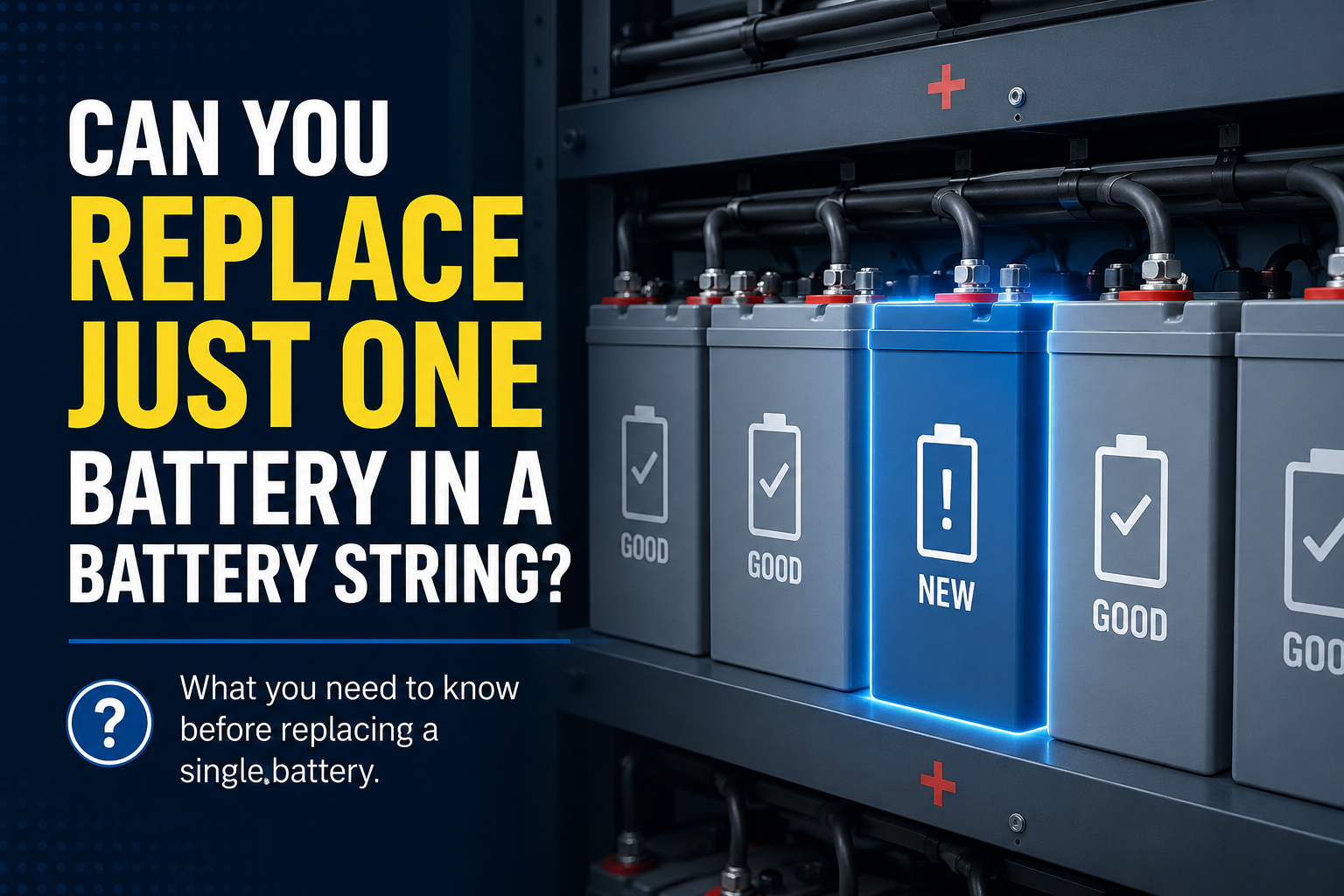
Can You Replace Just One Battery in a Battery String?
The short answer: Sometimes—but in most critical power applications, replacing only one battery is not the best long-term solution.
Whether you're maintaining a UPS system, telecom backup power system, utility substation, or emergency power system, replacing a single failed battery without evaluating the entire battery string can create reliability issues that outweigh the initial cost savings.
Understanding when a single battery replacement is appropriate—and when an entire string should be replaced—can help avoid unexpected downtime, reduced runtime, and unnecessary maintenance costs.
Why Batteries Work as a Team
Most critical power systems operate using multiple batteries connected together to achieve the required voltage and capacity.
Examples include:
- 40 batteries for a 480V UPS
- 60 batteries for a 125VDC utility station battery
- 24 batteries for a telecom system
- Hundreds of cells in large industrial battery banks
In these systems, every battery contributes equally to overall performance.
The entire string is only as strong as its weakest battery.
If one battery begins to deteriorate, the entire string's performance can suffer.
What Happens When One Battery Fails?
Many people assume they can simply remove the failed battery and install a new one.
While this may restore operation temporarily, it doesn't necessarily restore the performance of the battery string.
Here's why.
A brand-new battery has:
- Higher capacity
- Lower internal resistance
- Different charging characteristics
- Lower age-related degradation
The remaining batteries may have been operating for five, seven, or even ten years.
Mixing new and aged batteries creates an imbalance within the string.
The "Weak Link" Problem
Imagine a chain made of 40 links.
Replacing one worn link with a brand-new one doesn't strengthen the remaining 39 links.
Battery strings behave much the same way.
Although the new battery may perform perfectly, the older batteries continue to determine:
- Overall runtime
- Capacity
- Voltage stability
- Reliability during an outage
The string still performs like an aging battery system.
Why Mixing Battery Ages Can Cause Problems
When batteries of different ages are connected together, several issues can develop.
Uneven Charging
Older batteries generally require more charging current to maintain full capacity.
A new battery reaches full charge more efficiently.
This imbalance can cause the charger to maintain conditions that are less than ideal for one portion of the string.
Capacity Differences
Suppose your original batteries have degraded to approximately 75% of their original capacity.
Installing one new battery with 100% capacity does not increase the string's capacity to 100%.
Instead, the entire string is still limited by the remaining older batteries.
Internal Resistance Differences
As batteries age, internal resistance increases.
Higher internal resistance produces:
- More voltage drop under load
- Additional heat
- Reduced high-rate performance
A new battery cannot compensate for increased resistance throughout the rest of the battery string.
When Replacing One Battery May Be Appropriate
There are situations where replacing a single battery is reasonable.
Examples include:
Physical Damage
A battery damaged during installation or shipping.
Manufacturing Defect
An individual battery that fails under warranty while the remaining batteries are relatively new.
Very Young Battery Systems
If the battery string is less than one or two years old and testing confirms the remaining batteries are healthy, replacing a single battery is often acceptable.
Accidental Damage
A cracked case or damaged terminal caused during maintenance.
In these situations, replacing one battery may restore the system without introducing significant imbalance.
When You Should Consider Replacing the Entire String
Replacing the entire string is generally recommended when:
- Batteries are approaching design/service life.
- Multiple batteries have already failed.
- Capacity testing shows significant degradation.
- Internal resistance is increasing across multiple batteries.
- Runtime requirements are no longer being met.
- The application is mission critical.
If one battery fails in a seven-year-old battery string, it is often an indication that other batteries are approaching the end of their useful life.
Replacing only the failed battery may simply delay additional failures.
A Real-World Example
- A healthcare facility operates a UPS system supporting critical patient equipment.
- The battery string consists of forty 12-volt VRLA batteries that have been in service for nearly eight years.
- Routine maintenance identifies one battery with an internal short.
- The maintenance team replaces only the failed battery.
- Two months later, another battery fails.
- Three months after that, capacity testing shows the entire battery string has declined below the facility's minimum runtime requirement.
- The hospital ultimately replaces the entire battery string.
- The initial single-battery replacement restored operation temporarily but did not address the aging condition of the remaining batteries.
- Had the overall battery health been evaluated when the first failure occurred, the facility could have scheduled a proactive replacement rather than responding to multiple service events.
Questions Every Facility Manager Should Ask
Before replacing a single battery, consider the following:
- How old is the existing battery string?
- What is the battery's design/service life?
- Has the string undergone recent capacity testing?
- Are internal resistance values increasing?
- Have other batteries shown signs of deterioration?
- Is this a mission-critical application?
- What would an unexpected outage cost?
The answers to these questions often determine whether replacing one battery—or the entire string—is the most cost-effective decision.
Best Practices for Battery Replacement
Before replacing any battery, we recommend:
- Review the age of the entire battery string.
- Analyze maintenance and testing records.
- Compare internal resistance trends.
- Perform conductance or impedance testing.
- Verify actual runtime requirements.
- Consider the total cost of ownership rather than the cost of a single battery.
A comprehensive evaluation helps ensure the battery system will continue to meet operational requirements long after the repair is complete.
Frequently Asked Questions
Can I mix new and old batteries?
In most critical power applications, it is not recommended. Mixing batteries of significantly different ages can lead to charging imbalances and reduced overall system performance.
Will one new battery increase my runtime?
Not significantly. The battery string's performance is still determined primarily by the remaining older batteries.
Is replacing one battery ever acceptable?
Yes. If the battery string is relatively new and testing confirms the remaining batteries are healthy, replacing a single battery may be appropriate.
Should I replace all batteries if only one fails?
Not always—but if the battery string is approaching the end of its design/service life or multiple batteries show signs of degradation, replacing the entire string is often the more reliable and cost-effective solution.
How do I know if my battery string should be replaced?
Battery age, capacity testing, internal resistance trends, runtime testing, and maintenance history all provide valuable information. Evaluating these factors together offers a much more accurate assessment than replacing batteries one at a time.
Let Wholesale Batteries Help You Make the Right Decision
Every battery replacement decision involves balancing reliability, cost, and risk. Replacing a single battery may solve today's problem—but understanding the health of the entire battery string helps prevent tomorrows.
At Wholesale Batteries, we assist data centers, hospitals, utilities, telecom providers, manufacturers, and contractors with battery evaluations, replacement planning, capacity testing, and nationwide installation services. Whether you need one replacement battery or a complete battery system upgrade, our team can help identify the solution that best fits your application.
Before making your final decision, use our downloadable battery replacement evaluation checklist to ensure you're considering all critical factors.
Any Battery. Any Time. Delivered Anywhere.