Your cart is empty.

When specifying replacement batteries for UPS systems, telecom networks, utility substations, and other critical power applications, one of the most common mistakes is selecting a battery based solely on amp-hour (Ah) capacity.
At first glance, this seems logical. If a battery is rated at 100Ah, replacing it with another 100Ah battery should provide the same performance, right?
Unfortunately, it's rarely that simple. In critical power environments, battery performance is determined by much more than capacity alone. Selecting batteries based only on amp-hour ratings can lead to reduced runtime, premature battery failure, warranty issues, and even critical system outages.
An amp-hour rating is typically measured over a long discharge period, often 8, 10, or 20 hours. However, most UPS systems, data centers, and utility applications do not discharge batteries over 20 hours. Instead, they require extremely high current for short durations such as:
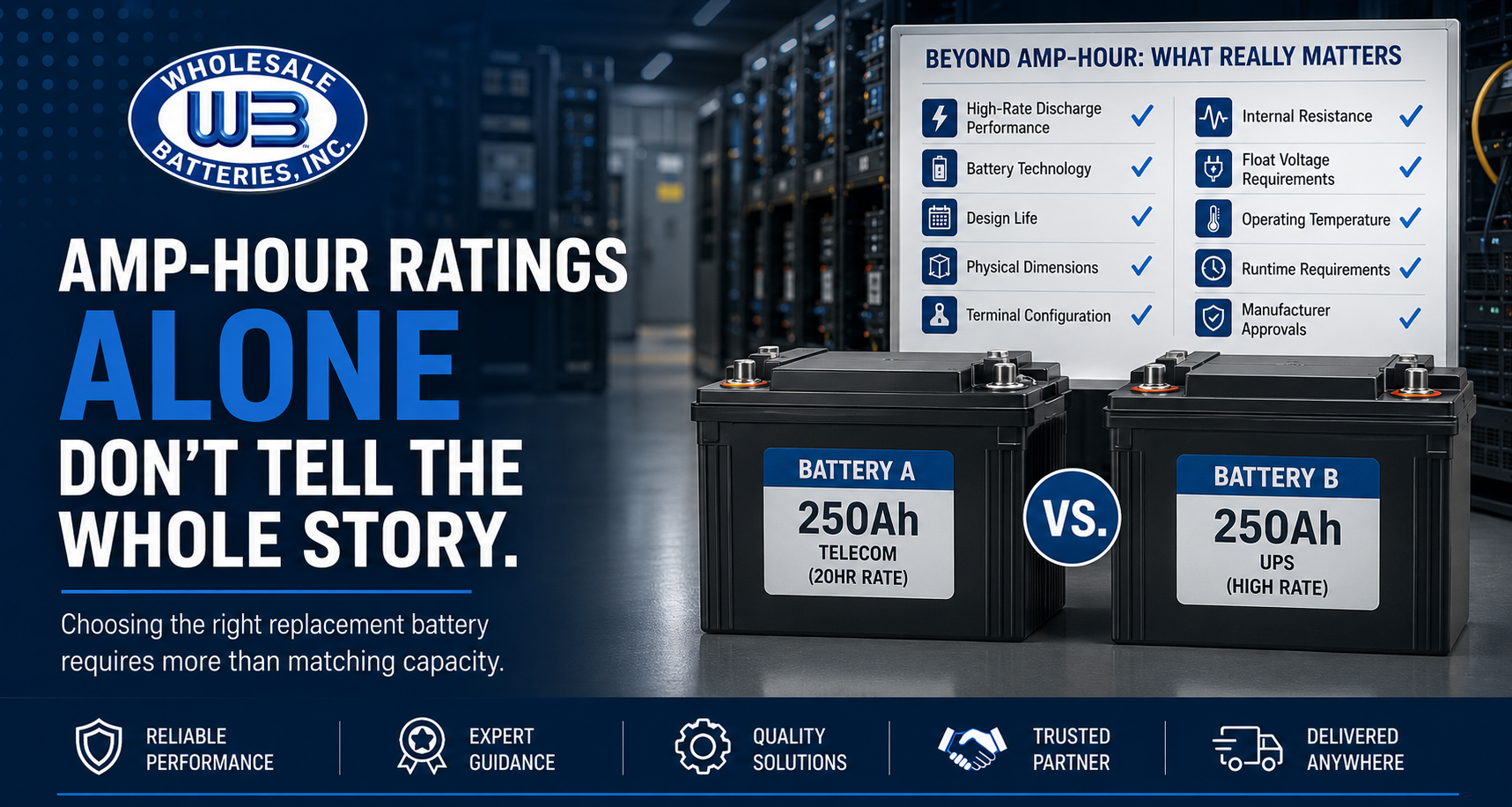
A battery designed for long-duration telecom applications may have the same amp-hour rating as a battery designed for high-rate UPS applications, yet deliver dramatically different performance during an actual outage.
For example:
A 250Ah telecom battery and a 250Ah UPS battery may appear identical on paper.
Under a 15-minute discharge, however, the UPS battery may deliver significantly more power due to differences in plate design, internal resistance, and construction.
In UPS applications, watts-per-cell (WPC) ratings are often more important than amp-hour ratings.
Manufacturers frequently design batteries specifically for short-duration, high-current discharges.
For example:
Not all VRLA batteries are created equal.
Common technologies include:
Each technology offers different advantages regarding:
A battery's chemistry and construction often impact performance more than its capacity rating.
Many buyers and decision-makers frequently overlook design life when sourcing replacements.
Typical options include:
Installing a lower-life battery into a system originally designed for long-life batteries may reduce maintenance intervals and increase total ownership costs.
Even batteries with similar ratings may have completely different:
This becomes especially important when batteries are installed in:
A battery that meets electrical requirements but does not physically fit is not an acceptable replacement.
Terminal design can vary significantly between manufacturers.
Common configurations include:
Incorrect terminal placement can require new intercell connectors, cable modifications, or complete rack reconfiguration.
Internal resistance directly impacts:
Lower internal resistance generally provides better UPS performance during large load events.
Two batteries with identical Ah ratings may have substantially different internal resistance values and therefore perform differently under load.
Different battery technologies require different charging parameters.
Before approving an alternative battery, users should verify:
Failure to do so can reduce battery life and void warranties.
Temperature has a significant impact on battery life.
Manufacturers may rate batteries differently based on:
Understanding expected operating conditions is critical when evaluating alternatives.
The ultimate purpose of a battery system is to support a load for a specified period.
Rather than matching amp-hours, decision-makers should verify:
The battery should be selected based on the application's runtime requirements, not simply by matching a capacity number.
Many UPS manufacturers publish approved battery lists.
Installing an unapproved battery may affect:
Always verify manufacturer requirements before selecting an alternate battery.
Instead of asking: "What battery has the same amp-hour rating?" The better question is: "What battery provides equivalent performance for this specific application?"
A proper battery replacement evaluation should consider:
Only after reviewing all of these variables can a true equivalent battery be identified.
At Wholesale Batteries, we help facility managers, contractors, purchasing professionals, data center operators, telecom providers, utility companies, and other critical power professionals identify true battery equivalents—not just batteries with matching amp-hour ratings Whether you're replacing a single battery, upgrading an entire UPS system, or evaluating alternatives due to lead time constraints, our team can review your application and recommend solutions that maintain system performance and reliability.
Wholesale Batteries reviews battery replacements every day and routinely finds batteries with identical amp-hour ratings that are not suitable replacements due to differences in discharge performance, dimensions, terminal design, charger compatibility, or manufacturer approval requirements.
Any Battery. Any Time. Delivered Anywhere.